
There has been a heated debate between celebrity MUA Patrick Ta and independent creator Ngozi Esther Edeme known as Painted by Esther, highlighted in the Dazed Digital article "Can you own a beauty technique?" . The controversy arose following the release of Ta's "transition blush" collection, which raises crucial questions within the modern beauty industry about trend ownership, history, and cultural equity.
At first, the distinction between the dispute and Black culture might seem unclear, but the situation exposes a much deeper systemic issue. Throughout history and even now, Black creators and makeup artists have frequently seen their signature styles techniques, and also trends adopted and commercialized by major mainstream brands that have failed to give any credit or recognition to the original creator, let alone any financial compensation. Esther tailored and modernized the technique which enabled the look to suit darker skin tones, defining a viral glam aesthetic for renowned clients such as Tyla and Naomi Campbell.
It becomes an issue when a large brand subsequently packaged a nearly identical routine as an discovery of their own. It shows a recurring pattern of cultural erasure for profit. Platform algorithms also seem to heavily favor celebrity artists and macro-influences over the independent creators, which leads to overshadowing and profiting of black artistry.

On the other hand, beauty history reveals that techniques such as gradient blending and draping are not entirely new at all. They have been initiated decades prior by legendary makeup artists such as Kevyn Aucoin. Because makeup is fundamentally repetitive, almost every contemporary technique is a rework of past looks. So did neither Patrick Ta nor Esther invent the concept of gradient blush?
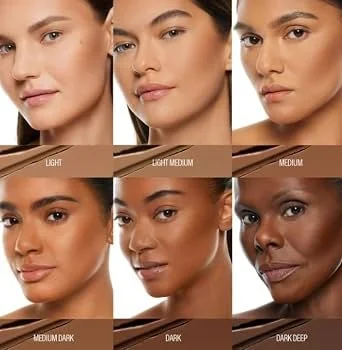
To answer this let’s look at another example, “The contour king” himself, Mario Dedivanovic. Mario became globally renowned for his heavy contour and sculpting technique on Kim Kardashian. He later went on to release Makeup by Mario, a widely recognized and profitable cosmetics line. Now, we know Mario didn’t invent contour, it has been used for hundreds of years in theatre, so what makes this any different from Patrick Ta’s release? …. well Mario actually acknowledges he didn’t invent the technique. In fact he feels uncomfortable being called “The Contour King” and gives much credit to the communities that influenced his work, explicitly linking the techniques he uses to both drag and theatrical history. This is, for me the most important thing about being in the industry and adapting other peoples work.
This dynamic places the industry in a complicated grey area, which balances historical roots, cultural representation, and corporate power. The beauty industry is a heavily oversaturated market, where everyone inspires someone in some way, shape or form. It raises critical questions such as can a technique be patented? Technically, no they can’t, aesthetic and creative methods are seen as artistic processes and not technical solutions. This is where the law fails artists, whilst the actually friction of an idea (such as a tutorial or a guide) can be copyrighted, the application technique itself cannot. This creates a legal loophole that enables corporate cosmetic brands and celebrity MUAs to exploit the work of independent creators.
Overall, i fully agree with Ngozis’ comments. I can agree that nearly every makeup today is a form of historic makeup, just adapted in someway, and we can’t argue the fact a technique cannot be patented. Ngozi has stated herself she has never claimed to have invented the trend once. However, I don’t agree with how Patrick Ta has gone about this at all. Both Ngozi and Mario have acknowledged their inspiration and stated that their adaptions were essential to tailor to their clients needs. Where as Patrick has just basically stated he’s the inventor and creator and acknowledged no one. Patrick has lost some brownie points with me.
Let me know your thoughts in the comments.
References used:
Reference article: https://www.dazeddigital.com/beauty/article/70411/1/how-blush-became-a-battleground-for-ownership-patrick-ta-ngozi-esther-edeme accessed on 28/09/2026
Title image: https://www.instagram.com/p/DRvE3uejjO3/ accessed on 28/09/2026
image: https://www.dazeddigital.com/beauty/article/70411/1/how-blush-became-a-battleground-for-ownership-patrick-ta-ngozi-esther-edeme accessed on 28/09/2026
image: https://dailycollegian.com/wp-content/uploads/2026/02/Painted-by-Esther-Image.jpeg accessed on 28/09/2026
image: https://images.squarespace-cdn.com/content/v1/63beb1552f2a41471a264ee4/1678737448730-HQROROXHJ57826QLEZJZ/kevyn%2B1%2B%281%29.jpg accessed on 28/09/2026
image: https://m.media-amazon.com/images/I/514QQLPga5L._AC_UF350,350_QL80_.jpg accessed on 07/10/2026

Video: https://www.youtube.com/shorts/BN3UXcMhtWU accessed on 05/10/2026